
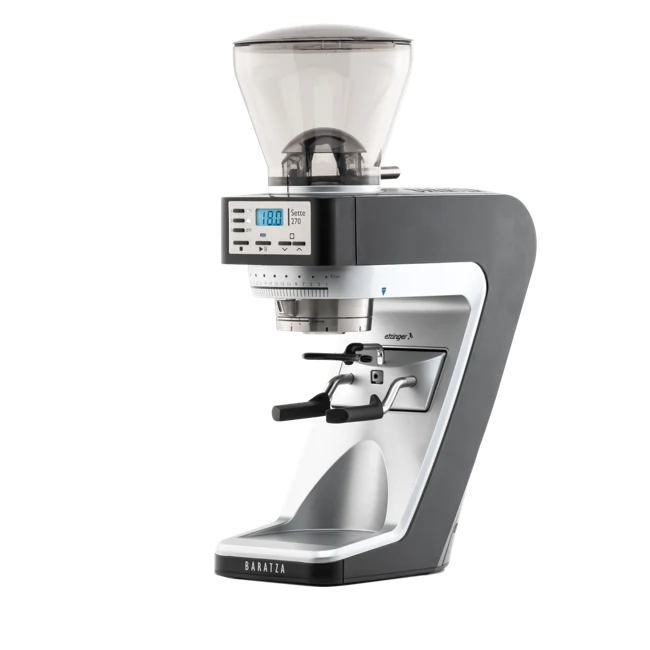
Your needs, this model
Does it fit your priorities?
Can it run a saved time directly into a supported portafilter?
Yes. The convertible arms and adjusted hook support the handle, and the operating manual explicitly permits timed grinding in that position. Check level support before use.
Explore this need in the finder →Can I stop a small amount of filter grounds by releasing the start button?
Yes. The manual pulse mode runs while the start button is held after entering that mode. The supplied bin is a documented receiving option.
Explore this need in the finder →Do the three presets weigh three different espresso doses?
No. They store durations. The Sette 270 manual does not describe an integrated target-weight system, and the presets do not change grind size.
Explore this need in the finder →For timed grinding into a handle or a bin
The Sette 270 is worth considering when you want to grind espresso directly into a supported portafilter and repeat a chosen grinding time. Its convertible receiving arms also accommodate the supplied bin and documented brewing devices. You do not have to describe those as the same routine: setting up a handle securely is a different job from sliding a bin beneath the outlet.
This is the time-based Sette 270. It should not inherit the weighing behavior of a Sette 270Wi simply because their names and outlines are similar. Choose it with an understanding that the user still establishes and checks the relationship between run time and the dose produced.
Three memories store time, not three grind recipes
The control panel stores three grinding durations. The manual describes fine time adjustment and a start, pause and stop sequence. A saved button changes the running duration; it does not move the burr adjustment to an espresso, filter or different-coffee setting.
That distinction matters if two people share the grinder. One preset can be associated with each regular drink in your notes, but both users must still select the appropriate grind position. A longer timer setting cannot compensate for an entirely different grind requirement.
After changing beans or altering the grind, check the amount delivered before relying on the old time. If your recipe is specified by weight, use a separate suitable scale. Nothing in the reviewed control sequence measures the finished grounds during that timed cycle.
Macro and micro controls do different jobs
The manual specifies 31 broad positions with a stepless finer adjustment between them. It provides starting regions for espresso, AeroPress, V60, drip and Chemex. The micro control is useful for refining a chosen broad position rather than repeatedly jumping across the whole range.
Follow the maker's instructions about adjusting with the motor running and clearing a little coffee after a change. Otherwise the first grounds received can still include coffee from the previous setting. A change on the dial and a fully changed dose are not necessarily the same instant.
The documented brew list supports espresso and several filter methods. It does not establish every possible coarse immersion method or prove a particular unpressurized basket will work with your coffee. For those stricter requirements, seek explicit evidence rather than interpreting the number of settings as a guarantee.
Fit the portafilter before starting the timer
For direct handle use, the receiving arms change position and a hook supports the top lip. Baratza instructs the user to adjust that hook so the portafilter sits level, then test the position during grinding. A handle that merely rests on the arms is not necessarily correctly supported.
The same manual allows timed operation into the portafilter, the bin or another supported brewing device. It also gives a genuine held-start-button pulse mode, stopping on release. Both timed and manual operation therefore have documented receiving arrangements; this is stronger evidence than combining two unrelated feature labels.
No exact universal portafilter diameter range is established here. Basket shape, lip and handle geometry still matter. Avoid allowing a pile of grounds to reach back into the outlet, whichever receptacle you choose.
Allow rest between batches
The reviewed edition describes short-duration home use and specific rests between espresso or brew batches. It does not make an unlimited-duty promise. Think through consecutive drinks as well as a single morning shot, and follow the operating edition's rest requirements.
A hopper can hold beans for successive doses, but that is not evidence of a separately specified single-dose capacity or automatic end-of-load stopping. This assessment leaves those capabilities unestablished rather than treating a timer as an empty-bean sensor.
Cleaning access is below the burr assembly
The manual's maintenance procedure removes the cone-burr and grind-adjustment assembly downward. It should not be described as a generic lift-out upper-burr procedure. Keep the hook clear, follow the alignment indicators and unplug for the disassembly and cleaning work.
The hopper and bin are hand-washed and thoroughly dried; burrs and the adjustment assembly are not washed. Follow the separate unclogging instructions if coffee has packed behind the outlet. This is a useful fit for attended home espresso and filter preparation with genuine timed handle support. It is a weaker fit if you primarily want a scale-controlled target, confirmed universal handle dimensions or continuous high-volume operation.
Sources: Baratza US Sette 270 reference and Sette 270 manual v2.1, August 2019.
Key details at a glance
| Maker-supported espresso use | Yes |
|---|---|
| Maker-supported filter brewing | Yes |
| Direct-to-portafilter dispensing | Yes |
| Grounds bin or dosing cup | Yes |
| Repeated-dose hopper use | Yes |
| Manual grinding stop | Yes |
| Programmable time stop | Yes |
| Integrated weight-controlled stop | No |
| Normal battery-powered grinding | No |
| Manufacturer household use | Yes |
Use the exact model’s instructions for operating limits, supplied equipment and version differences.
Sources for this assessment
Find a grinder for your daily coffee.
Compare the brewing methods, loading routine and dose controls you actually need.