
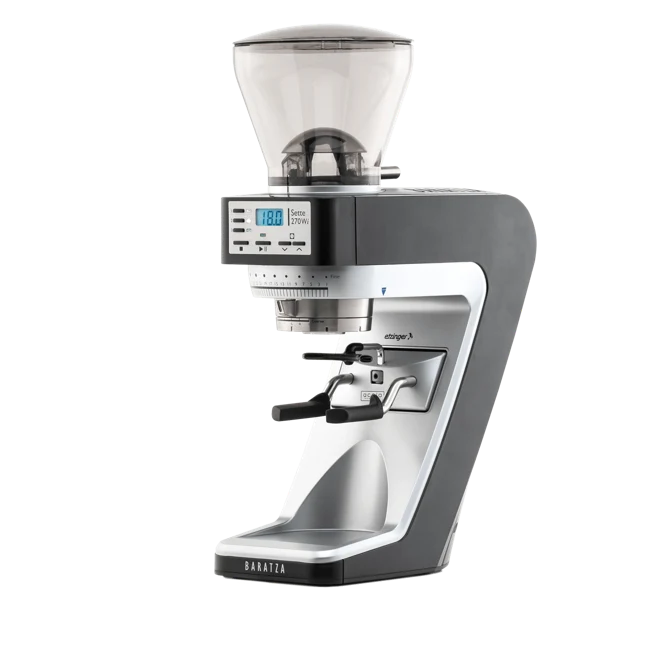
Your needs, this model
Does it fit your priorities?
Can I leave beans in the hopper and stop an espresso dose at a target weight?
Yes. 270Wi uses an integrated scale and saved weight targets, with a documented direct portafilter arrangement. Keep at least two doses of beans in the hopper as its instructions require.
Explore this need in the finder →Can the same weight program work with one pre-weighed bean dose each time?
The maker expressly says not to single dose this model. Its automatic stopping learns from throughput and previous cycles, so a target-weight feature does not establish that loading workflow.
Explore this need in the finder →Can I choose when grinding stops instead of using a weight preset?
Yes. The manual describes a pulse mode that runs while the start button is held and stops on release. This is separate from resetting or pausing a programmed weight cycle.
Explore this need in the finder →Weight-controlled espresso for a hopper-fed routine
The Baratza Sette 270Wi is a useful choice when you want the grinder to measure grounds as it dispenses and stop at a saved target weight. It supports direct delivery into a properly fitted portafilter as well as the supplied bin. Its central tradeoff is unusually important: the operating guide specifically tells owners not to load only a single dose of beans for its weight-controlled routine.
Choose it for a workflow in which beans remain available in the hopper between drinks. If weighing a fresh bean dose before every shot is non-negotiable, an integrated scale alone does not make this the right match.
Why the loaded hopper matters
The 270Wi software adjusts its stopping point using the rate of delivery and preceding cycles. Baratza's instructions call for at least two doses of beans to be present when grinding. That guidance directly conflicts with the expectation that any scale-equipped grinder should also be a purpose-built single-doser.
Think about the choice in terms of what you want to measure. One routine weighs beans before they enter a grinder; this one controls the weight of grounds delivered from a maintained supply. Both can be deliberate ways to work, but they create different refilling and coffee-switching habits.
The hopper shutoff helps when removing a store of beans. It does not cancel the loading requirement for accurate operation. Likewise, loading only a tiny amount because you are nearly out of coffee changes the conditions under which the automatic system is meant to work.
The scale controls stopping; the collars control grind size
Three presets save target weights. Selecting a different preset does not move the burrs to a new grind setting. The numbered macro adjustment and finer micro collar perform that separate job. This matters if you hope to save espresso and filter routines under two buttons: the target amount can be recalled electronically, while grind adjustment still needs your attention.
The manual gives starting guidance for espresso and several filter methods. Those positions are suggestions for dialing in, not evidence that every roast will perform at the same number. Make deliberate changes and judge the resulting brew instead of treating the engraved letters as a universal recipe.
The weight display's resolution is also different from a guarantee of measured accuracy in every environment. Put the machine on a stable surface, fit the receiving vessel correctly and avoid disturbing it while a dose is being weighed.
Direct-to-portafilter requires a proper fit
The convertible arms and adjustable hook support the portafilter arrangement. The guide instructs you to set the hook so the handle sits level, tighten it and check the fit during a test grind. A broad statement that a holder accommodates popular handles is not a documented fit for every diameter and handle shape.
Do that fitting work with the portafilter you intend to use. A tilted vessel or grounds backing up into the outlet undermines the convenience you were trying to gain. For a filter batch, change to the bin position and keep the collecting space clear.
Manual control remains available
A documented pulse mode runs the motor while the start control is held and stops when it is released. It is useful when you want to make the stopping decision yourself. Normal weight presets have a five-gram minimum in the reviewed manual; the scale should not be assumed to provide dependable automatic targets below that limit.
Pause and stop have different effects during a weight cycle. Pause preserves progress for resuming toward the same target, whereas stop resets the cycle. Understanding that distinction is more helpful than repeatedly starting a fresh target after part of a dose has already been dispensed.
Plan for rest and cleaning
The reviewed instructions describe short-duration home use and required rest between grinding operations. A large filter batch has a different rest requirement from a single espresso dose. Follow the duty guidance for the intended batch rather than assuming the professional-looking controls imply continuous cafe service.
For cleaning, the guide removes the cone-burr and adjustment assembly from below after the food path has been cleared and power disconnected. That is not evidence that an upper burr comes out through the top for routine care. Keep the burr assembly dry and follow its marked reinstallation sequence.
270Wi fits the owner who wants a loaded-hopper espresso routine, supported direct delivery and integrated target-weight stopping. The ordinary Sette 270 uses time-based dosing instead; it should not be substituted for the Wi's weighing function. For frequent changes between pre-weighed bean doses, choose a model whose normal single-dose instructions support that exact habit.
Sources: Baratza US Sette 270Wi reference, 270Wi v2.4 operating guide and exact-model support hub.
Key details at a glance
| Maker-supported espresso use | Yes |
|---|---|
| Maker-supported filter brewing | Yes |
| Direct-to-portafilter dispensing | Yes |
| Grounds bin or dosing cup | Yes |
| Supported single-dose loading | No |
| Repeated-dose hopper use | Yes |
| Manual grinding stop | Yes |
| Programmable time stop | No |
| Integrated weight-controlled stop | Yes |
| Normal battery-powered grinding | No |
| Manufacturer household use | Yes |
Use the exact model’s instructions for operating limits, supplied equipment and version differences.
Sources for this assessment
Find a grinder for your daily coffee.
Compare the brewing methods, loading routine and dose controls you actually need.