
Your needs, this model
Does it fit your priorities?
Does it document timed espresso directly into a 58 mm single-wall basket?
Yes. The US guide specifically supports single-wall baskets and includes a 58 mm cradle. Check the actual handle seating and establish the right timed dose.
Explore this need in the finder →Can I use manual control into the bin for filter or French press?
Yes. Container collection and a separate held-control manual mode are both documented, alongside the timed programs.
Explore this need in the finder →Will it weigh a chosen number of grams into my portafilter?
No. The standard control system uses time or manual operation, not an integrated target-weight scale.
Explore this need in the finder →A timed grinder that can work directly with espresso baskets
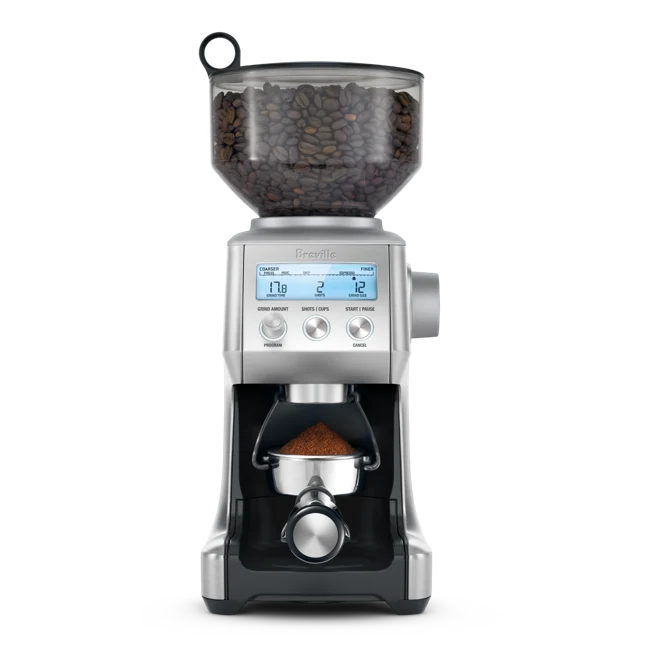
The Smart Grinder ProBCG820 is a household conical-burr grinder with a digital timer, separate manual operation and documented receiving choices. It can grind into a supported portafilter, its container or an appropriate filter basket. That flexibility is more useful to assess than the marketing name alone.
The reviewed US instruction edition explicitly discusses single-wall espresso baskets as well as dual-wall filters. This is stronger evidence for a conventional unpressurized espresso workflow than merely finding espresso written beside a fine setting.
Choose the right cradle, without inventing a continuous range
The supplied small cradle is documented for 50–54 mm portafilters, while a separate large cradle supports 58 mm. Those are two supported size groups. They do not establish that a 55,56or57 mm handle fits between them.
Insert the appropriate cradle and check the actual handle seating. Diameter is only one part of fit: lip, spout and handle geometry still need to work with the support. A nominal match should not be represented as a guarantee for every basket shape.
For container or filter collection, the manual removes the cradle and places the chosen receiver below the outlet. This is a documented alternative, not a workaround requiring the reader to defeat an interlock.
The quantity program is time-based
The display shows grind choice, shots or cups and grinding time. The quantity is controlled by a digital timer, with fine time changes and saved programs for the selected quantity. It is not controlled by an integrated scale weighing the grounds.
Establish a recipe with your coffee, basket and machine, then check the amount received. When changing coffee or fineness, recheck the dose before relying on a saved time. A shots label is a convenient program category rather than a universal mass of coffee.
The book also gives a pause function that lets the user settle grounds and resume within the stated interval. Pause, cancel and program have different jobs; follow the instructions so an interrupted dose is not accidentally treated as a new full cycle.
Manual grinding is genuinely separate
Holding the start control or the portafilter activation switch runs the grinder until release. This is actual manual operation, alongside the automatic timed sequence. Both are documented with direct-handle use, and container collection is also supported.
That distinction lets an attended user choose how a particular dose ends. It does not add target-weight stopping or detection that every bean in a preweighed load has finished. Those would require different operating evidence.
Use the grind dial and upper-burr adjustment deliberately
The operating guide covers espresso, filter and French press across 60 dial positions. It also provides an upper-burr adjustment for extending the working range when needed. Change one adjustment at a time and record what you did.
Start with the ordinary external dial and the maker's brew guidance. Internal adjustment should address a real range problem, not become a routine second variable changed whenever a shot is disappointing. A documented adjustment mechanism still is not an independently measured taste result.
The selected L26 instruction edition calls its bean hopper one pound, approximately 453.6 g. That figure belongs to this edition; older capacity descriptions should not be combined with it. The reservoir-to-dose workflow does not establish a specified standard single-dose loading range.
Make cleaning access part of the setup
The upper burr is removable for brushing after the proper emptying, unplugging and unlocking steps. Clean the lower burr and outlet too, then seat and lock the upper assembly and hopper correctly. A locked hopper is required for normal operation.
The book hand-washes the specified hopper and receiving accessories and prohibits dishwasher cleaning of grinder parts. Keep the burrs dry and follow the stated running and cooling limits rather than using a household grinder continuously.
The reviewed electrical rating is 120 V60 Hz. Choose this exact US operating configuration for timed or manual direct-handle espresso plus bin-based brewed coffee. Choose another documented control system if the essential is weighing the output automatically. The Pro's digital display does not supply that missing scale.
Sources: Breville BCG820 US instruction book, L26 and Breville US Smart Grinder Pro reference.
Key details at a glance
| Maker-supported espresso use | Yes |
|---|---|
| Maker-supported filter brewing | Yes |
| Maker-supported French press use | Yes |
| Nonpressurized-basket workflow | Yes |
| Direct-to-portafilter dispensing | Yes |
| Grounds bin or dosing cup | Yes |
| Repeated-dose hopper use | Yes |
| Manual grinding stop | Yes |
| Programmable time stop | Yes |
| Integrated weight-controlled stop | No |
| User-removable upper burr | Yes |
| Normal battery-powered grinding | No |
| Manufacturer household use | Yes |
| Manufacturer commercial use | No |
| Nominal bean-hopper capacity | 453.6 g |
| Documented direct portafilter sizes | 50–54 mm; 58 mm |
Use the exact model’s instructions for operating limits, supplied equipment and version differences.
Sources for this assessment
Find a grinder for your daily coffee.
Compare the brewing methods, loading routine and dose controls you actually need.