
Your needs, this model
Does it fit your priorities?
Can an existing CBM-20 grind into a filter as well as its bin?
Yes. The original guide supports several receiving arrangements and explains filter clips, the shelf and overflow precautions. Check the exact filter shape and receiving capacity.
Explore this need in the finder →Can I manually grind directly into a supported espresso portafilter?
The original guide lists portafilters among supported destinations and documents both modes. It does not establish universal hands-free fit or a compatible diameter list.
Explore this need in the finder →Does its LCD stop the motor at a chosen weight?
No. It shows a cup-selected countdown and settings, not integrated weight-controlled dosing. A separate external weighing step does not change that stopping mechanism.
Explore this need in the finder →A discontinued grinder with unusually flexible receiving options
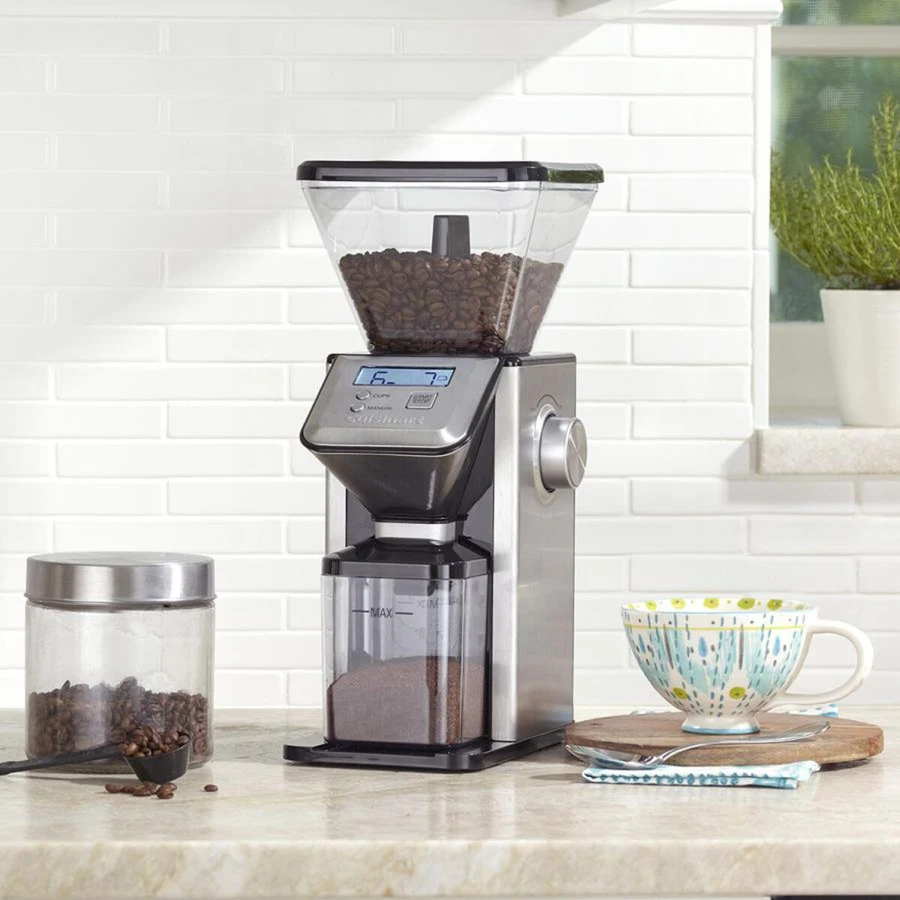
The Cuisinart CBM-20 Deluxe Grind is most useful to understand as a documented older home grinder that can deliver into several kinds of receptacle. Its instructions support the included chamber, filters, a portafilter and certain reusable single-serve cups. It also has a genuine held-button manual mode, alongside the cup-selected automatic cycle.
Cuisinart explicitly labels this model discontinued. That does not erase the operating information or make an existing unit unusable, but it does change the decision: check the actual model, condition and compatible parts rather than treating an old product reference as a current manufacturer offer.
Decide what will sit beneath the outlet
The manual provides paper-filter clips and a fold-down shelf arrangement. It distinguishes cone and basket filters, and advises supporting larger paper-filter loads rather than expecting the clips to hold any weight. The receiving choice needs to be planned before starting the dose.
For a Cuisinart HomeBarista reusable cup, the guide positions it on the shelf and recommends a small cup-count selection to avoid overflow. Other reusable capsules may need to be held beneath the spout. Compatibility with one named cup is not a guarantee that every capsule shape fits that shelf.
A portafilter is explicitly a supported receiving destination, but the guide does not supply a universal diameter range or a promise that every handle is secured hands-free. This is useful direct delivery when the actual position works; it is not a reason to skip checking the vessel and clearance.
Automatic cup selection and manual control
The automatic program selects one to fourteen cups and displays a countdown. The amount is governed by that time-based cycle, not by a scale weighing the grounds. Pause preserves a cycle for resuming, while holding the stop control cancels it.
The separate Manual button is different from merely canceling a program. Hold it to grind until the desired amount is reached, subject to the guide's approximate one-minute safety limit. That makes manual control useful for a smaller receptacle, provided you watch the filling space.
There is no documented target-weight mode. An external scale can help check a recipe, but the machine cannot be assumed to stop when that external reading reaches the chosen number. Pick the stopping method consciously rather than reading the LCD as proof of integrated weighing.
Brew range and bean loading
The guide assigns eighteen grind positions across espresso, automatic drip and French press. Those are maker starting ranges, not measured comparisons of cup quality. They do not establish the stricter nonpressurized-basket requirement simply by using the espresso name.
The hopper holds a nominal pound of whole beans. Its locking arrangement allows it to be removed for emptying. The instructions describe keeping enough beans for the selected amount; they do not establish an automatic routine for one pre-weighed bean load or promise that all of that load will be recovered.
With different receiving vessels, remember that hopper capacity and destination capacity are independent. A large supply above the burrs does not prevent a paper filter or small cup from overflowing beneath them. Choose an amount that suits the actual receptacle.
Cleaning follows this model's own directions
The original instructions describe removing the upper burr assembly by its metal handle. They permit brushing or hand-washing that removable part, while separately allowing designated containers on the dishwasher's top shelf. That is model-specific guidance, not permission to wash other grinders' steel burrs.
Unplug for removal and cleaning, dry the permitted washed components thoroughly and align the release marks during reassembly. The hopper will not attach properly if the burr is not fully seated. A difficult fit is a reason to check alignment, not to force the locking parts.
The manual also tells owners to clear a blocked chute and gives an overheat recovery procedure. Keep the grounds below the receiving vessel's limit and follow the household-only scope. A motor protection shutdown is not the planned end of a production run.
CBM-20 is a useful historical match for manual or cup-timed home grinding into several documented receptacles. Compare an exact current model for an ordinary new purchase, and compare a true weighing design if your goal is automatic grams rather than receptacle flexibility.
Sources: Cuisinart discontinued CBM-20 reference and original manufacturer operating manual.
Key details at a glance
| Maker-supported espresso use | Yes |
|---|---|
| Maker-supported filter brewing | Yes |
| Maker-supported French press use | Yes |
| Direct-to-portafilter dispensing | Yes |
| Grounds bin or dosing cup | Yes |
| Repeated-dose hopper use | Yes |
| Manual grinding stop | Yes |
| Programmable time stop | Yes |
| Integrated weight-controlled stop | No |
| User-removable upper burr | Yes |
| Normal battery-powered grinding | No |
| Manufacturer household use | Yes |
| Manufacturer commercial use | No |
| Nominal bean-hopper capacity | 453.6 g |
Use the exact model’s instructions for operating limits, supplied equipment and version differences.
Sources for this assessment
Find a grinder for your daily coffee.
Compare the brewing methods, loading routine and dose controls you actually need.