
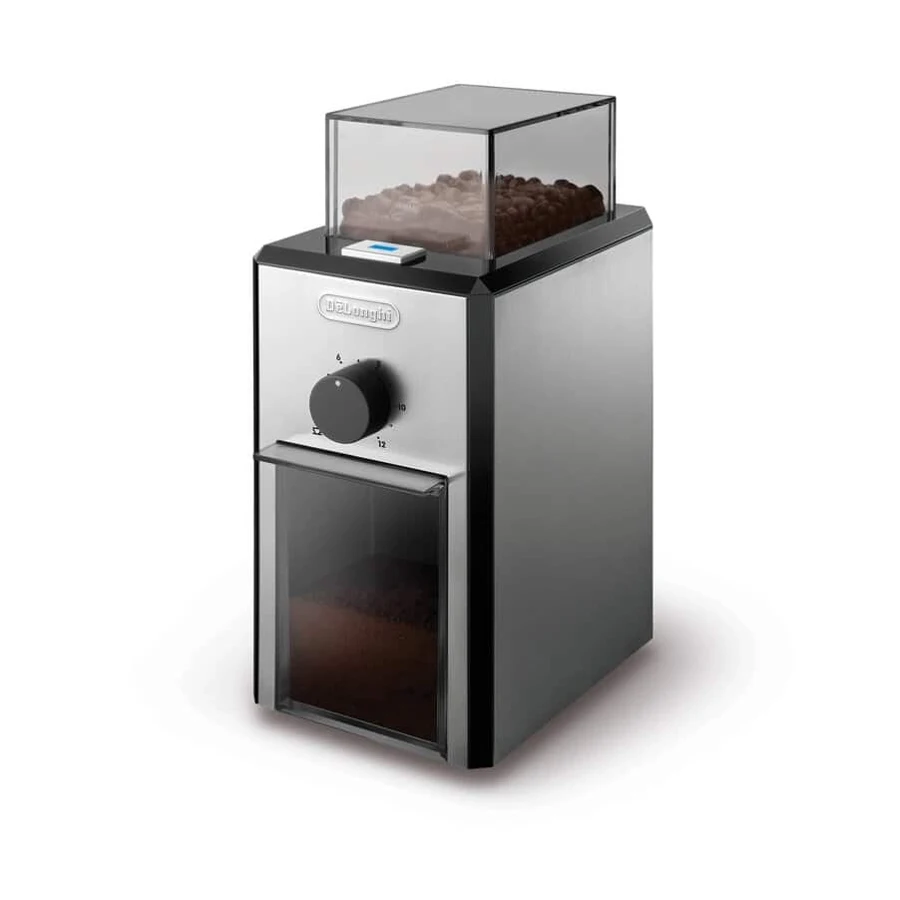
Your needs, this model
Does it fit your priorities?
Is the reviewed KG89 version documented for ordinary US mains?
Yes. The exact US support-linked cover identifies KG79/89 at 120 V/60 Hz. A separate 220–240 V regional booklet also exists, so confirm the physical unit rather than assuming everyKG89 listing has this rating.
Explore this need in the finder →Can I use one home grinder for drip coffee and French press?
Both methods are in this US operating chart, and the documented routine collects grounds in a container. The cup dial is an approximate quantity guide, not a selected weight in grams.
Explore this need in the finder →Can I lift out the upper wheel for routine cleaning?
Yes. The US manual gives an explicit upper-burr removal and reinstallation procedure after unplugging. The burr must remain dry; washing a container is a separate task.
Explore this need in the finder →The KG89 suits a home routine where you want to choose coarseness and a nominal batch size, then collect the grounds in a container. It is a simpler proposition than a grinder built around a screen full of dose programs. The reason to shortlist it is that ordinary hopper-to-bin arrangement, with documented upper-wheel access for cleaning.
Begin with the correct electrical version
This assessment uses the US operating material linked by DeLonghi's exact KG89 support page. Its cover identifies 120 V/60 Hz operation. Another manufacturer booklet for the KG79/89 family gives 220–240 V; that regional specification must not be copied into the US version or treated as proof that all versions are interchangeable.
Check the label on the actual unit, especially when considering an older or imported offer. A familiar model name is useful identification, but it is not a substitute for the reviewed operating version. We have not mapped an unspecified historical Amazon listing to this exact appliance.
A cup-selected cycle, with an approximate quantity
The US instructions describe selecting cups and coarseness, starting the grinder, and letting the selected cycle finish. They also describe stopping early if necessary. The grounds then come out of a separate lidded container for transfer to the brewer.
That cup dial is an amount guide. It does not establish an integrated scale stopping at a chosen mass, and the operating instructions explicitly treat coffee quantity as something to adjust for personal use. If your recipe is in grams, check the output with a suitable scale rather than assuming the cup marking is an exact conversion.
The current US product page also uses inconsistent cup-minimum wording. This review therefore does not promise a precise lowest setting from that page. The broader buying distinction remains clear: an approximate batch selector is a different function from repeatable gram-target control.
Match the brew guidance to your equipment
The US chart includes espresso, drip and French press. That provides a legitimate starting point when comparing a mixed-method household. It does not prove a measured particle distribution or guarantee that every conventional nonpressurized espresso basket can be adjusted to a particular shot recipe.
The container workflow matters too. If you are happy transferring grounds into a filter or basket, it may be entirely suitable. If your essential is direct, supported delivery into a particular espresso handle, require evidence of that accessory rather than assuming an espresso label includes it.
Upper-wheel access is documented
The instructions distinguish washing the specified container pieces from dry cleaning of the burr. They include an actual user procedure for removing and refitting the upper wheel after disconnecting power. That is stronger evidence than a generic removable-parts claim.
Correct reinstallation is part of normal ownership. If the coarseness control stops behaving properly after cleaning, the manual directs attention to the upper burr's seating. Follow the exact locking and selector positions rather than forcing the mechanism or borrowing a procedure from a different grinder.
Where a different design is more appropriate
The US instructions restrict the appliance to household use. Automatic operation and stainless exterior styling do not establish cafe duty. Likewise, an early-stop option is not enough to invent a separate programmable manual or timed dosing mode that the documents do not clearly describe.
Choose the KG89 for a straightforward home batch routine, maker-stated brew range and supported upper-burr cleaning. Prefer another verified model if you need integrated weight dosing, confirmed single-dose loading, an exact direct-portafilter fit or a strict body-size limit with clearly labelled measurements. Those choices address actual daily work, which is more helpful than ranking this grinder from a setting count alone.
Key details at a glance
| Maker-supported espresso use | Yes |
|---|---|
| Maker-supported filter brewing | Yes |
| Maker-supported French press use | Yes |
| Grounds bin or dosing cup | Yes |
| Repeated-dose hopper use | Yes |
| User-removable upper burr | Yes |
| Manufacturer household use | Yes |
| Manufacturer commercial use | No |
Use the exact model’s instructions for operating limits, supplied equipment and version differences.
Sources for this assessment
Find a grinder for your daily coffee.
Compare the brewing methods, loading routine and dose controls you actually need.