
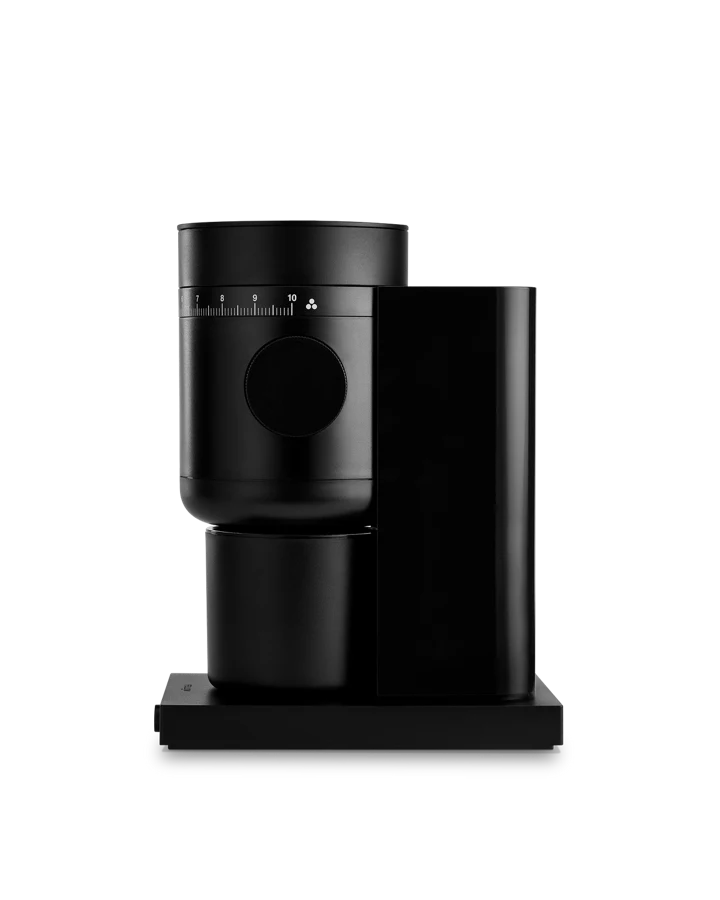
Your needs, this model
Does it fit your priorities?
Can I weigh a 60 g batch for French press and have the grinder stop when the loaded beans are finished?
Yes. Opus 2 documents a 100 g single-dose bin and normal empty-load auto-stop into the brewed-coffee cup. Observe the manual’s cycle and rest limits.
Explore this need in the finder →Can I grind straight into my58 mm espresso handle?
No. The 58 mm compatibility is for transferring from the espresso catch cup. It is not supported direct portafilter output.
Explore this need in the finder →Can it replace a grinder that stops at a target gram weight from a filled hopper?
No. Its normal routine measures the beans before loading and stops after the batch is ground; it does not provide that reservoir-fed weight-stop workflow.
Explore this need in the finder →The Fellow Opus 2 is a useful choice for someone who weighs beans for each brew and wants the grinder to stop after that load has been ground. It covers espresso and brewed coffee with separate catch cups. Choose it for that measured-batch routine, rather than for direct dispensing into an espresso handle or dosing repeatedly from a stored supply of beans.
A new model with a different stopping routine
Opus 2 is not an alternate name for the original Opus. The newer machine has 48 mm conical burrs, a side adjustment dial and an empty-load automatic stop. A brief press starts the normal cycle. The maker’s operating guide says the grinder detects when the load is empty and stops.
That changes the daily task in a useful way. You decide how much coffee to load, then collect the result without estimating a duration for each recipe. It is particularly relevant if you regularly change beans or make different quantities. You still need to measure the beans accurately; the grinder is not choosing the recipe or verifying the final weight for you.
Do not confuse empty-load stopping with integrated weighing. A machine can finish grinding a premeasured load without weighing the grounds in its catch cup. If your essential is a target-weight stop from a continuously filled hopper, select a grinder that actually documents that workflow.
Two cups, rather than a direct portafilter holder
The supplied brewed-coffee cup is rated for 100 g, while the smaller espresso cup is rated for 30 g. The espresso process collects coffee in that cup and then transfers it into the basket. Its 54 mm and 58 mm compatibility describes this transfer step, not a cradle that lets the grinder fill the portafilter directly.
For a person who enjoys keeping the espresso dose contained before transfer, that is an understandable arrangement. For someone who wants to insert a handle beneath the outlet and grind directly into it, it is the wrong output method. This distinction should carry more weight in your choice than a general claim that a grinder is espresso-capable.
The magnets help locate the receiving cup, but the safety instructions warn against placing the magnetic catch on an electronic scale. Plan to measure the bean dose using an appropriate separate vessel. Do not assume the supplied cup is automatically a suitable weighing accessory.
From espresso to a larger brewed batch
The standard single-dose load bin is specified at 100 g. Fellow gives guidance for espresso, pour-over, electric brewing and French press, with a fine-to-coarse side adjustment. Use the suggested ranges to establish a recipe, then record useful positions for the coffees you actually make.
Alternating between brew methods is most convenient when you can reproduce both the amount and the setting. Emptying the loaded batch can support that habit, but this assessment does not turn a manufacturer retention claim into a measured promise that every bean reaches the cup. Check your own recipe when a small dose difference matters.
This review selects the standard North American OP01AANA version. The plastic lid has measuring compartments; the wooden-upgrade version does not inherit that plastic-lid feature. Choose the package you prefer without assuming a different lid creates a different motor or a larger batch allowance.
Cleaning, duty limits and counter fit
The outer burr can be removed using its wire handle after the load bin is removed and the machine is unplugged. Dry brushing and careful reassembly are part of ownership. Do not wash the burrs or use a dishwasher as a shortcut.
The quick guide describes a separate long-press 45-second run, while the safety book advises cycles shorter than 45 seconds with rest between them. Use the normal empty-load routine within the safety limits and obtain clarification before treating that longer-run feature as permission for repeated back-to-back operation. The load-bin capacity alone is not a continuous-duty rating.
For a tight cabinet opening, verify the actual appliance before relying on a depth or height number: the current product page and safety book disagree about those dimensions. Their common width is 130 mm. Also allow practical access to the lid and cleaning parts; body dimensions are not operating clearances.
Who benefits most?
The US/Canada safety book specifies household use and 120 V, 60 Hz operation. Opus 2 is a strong routine candidate when you want single-batch loading, container collection and an empty-load stop across several brew methods. Look elsewhere for direct-handle output, a reservoir-fed weight dose or a commercial duty cycle. This assessment establishes those functional differences without claiming hands-on speed, flavor or retention results.
Key details at a glance
| Maker-supported espresso use | Yes |
|---|---|
| Maker-supported filter brewing | Yes |
| Maker-supported French press use | Yes |
| Direct-to-portafilter dispensing | No |
| Grounds bin or dosing cup | Yes |
| Supported single-dose loading | Yes |
| Repeated-dose hopper use | No |
| Programmable time stop | Yes |
| Integrated weight-controlled stop | No |
| Single-load empty stop | Yes |
| User-removable upper burr | Yes |
| Normal battery-powered grinding | No |
| Manufacturer household use | Yes |
| Manufacturer commercial use | No |
| Documented single-load maximum | 100 g |
| Body width | 130 mm |
Use the exact model’s instructions for operating limits, supplied equipment and version differences.
Sources for this assessment
Find a grinder for your daily coffee.
Compare the brewing methods, loading routine and dose controls you actually need.