
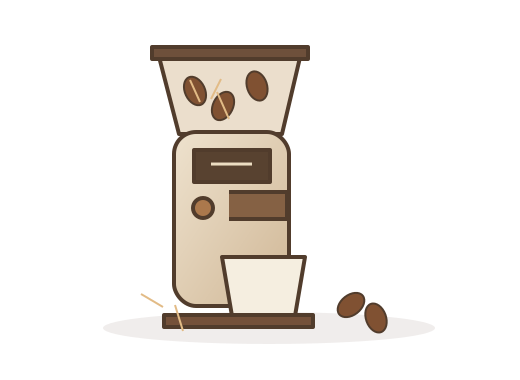
Your needs, this model
Does it fit your priorities?
Does the grounds container hold at least90 g?
The original guide gives a 95 g grounds-container limit. That is receiving capacity, not the bean-hopper capacity or a verified selected dose.
Explore this need in the finder →Does a cup-dose knob confirm a programmable timed stop?
No. The guide names a cup-dose selection but does not establish its timing mechanism. That requirement remains unconfirmed.
Explore this need in the finder →Can I use it continuously for a commercial batch?
No. The guide limits operation to household use and says not to run for longer than a minute at a time.
Explore this need in the finder →The GCG-168 has a distinctive documented operating sequence: select the grind and cup amount, switch on, then press the grounds-container lid downward to begin grinding. Understanding that receiver-and-lid arrangement is more useful to an owner than assuming it operates like every other cup-marked burr grinder.
The receiving setup is part of the control
The original guide requires the hopper and container lid to be secured and the grounds container to be in position. Coffee is collected there, after which the receiver slides out for emptying. A different vessel is not a confirmed replacement for that arrangement.
This is worth checking when inspecting an older unit. Confirm that the lid seats properly and that the receiving parts are present. A missing or cracked lid can affect the documented routine rather than merely spoil the appearance.
Keep bean storage and collected coffee separate
The guide describes the hopper in ounces and gives a 95 g grounds-container limit. The 95 g figure belongs to the receiver. It must not become a bean-loading specification or an automatic weight target.
For a practical batch, consider how much is already in the receiver before beginning another run. The grounds maximum line remains relevant even when the hopper has room for more beans. A cup setting is not permission to overfill the receiving container.
Someone following a weighed recipe should check the actual collected amount independently. That establishes how the selected control behaves with their beans and grind choice. It does not convert the machine into a scale-controlled grinder.
A cup selection does not explain the stopping mechanism
The available instructions name the cup-dose knob but do not establish a programmable duration or a selected-weight finish. They also do not clearly document release-to-stop behavior for the receiving lid. This review therefore keeps those stopping requirements unconfirmed.
If automatic completion at a chosen duration is essential, require a model whose exact guide explains that function. Similarly, loading only one weighed portion does not by itself establish automatic stopping when the beans are finished.
Cleaning within the actual permissions
The guide identifies burrs and warns against oiling or sharpening them. It describes cleaning the allowed lid and receiver parts, wiping the housing and keeping the motor base out of water. It does not establish a routine user-removable upper burr.
Disconnect power and follow the exact component instructions. A removable hopper in a product photograph would not authorize dismantling the grinding assembly, and a cleaning method for another Gourmia model should not be substituted.
Who should use this reference?
This is most helpful to an owner identifying the GCG-168's receiver, lid control and maintenance boundaries. The original guide limits it to household, noncommercial use and restricts an individual run to a minute. It is not a verified continuous-batch machine.
Before a new purchase, confirm the physical unit's supply label and any essential brew or dose requirement. The basis here is the original GCG-168 guide text. No GCG165 or GCG205 capacities, electrical ratings or scale features have been carried across.
Key details at a glance
| Grounds bin or dosing cup | Yes |
|---|---|
| Repeated-dose hopper use | Yes |
| Manufacturer household use | Yes |
| Manufacturer commercial use | No |
Use the exact model’s instructions for operating limits, supplied equipment and version differences.
Sources for this assessment
Find a grinder for your daily coffee.
Compare the brewing methods, loading routine and dose controls you actually need.